Where Apple, Google, Meta & Nvidia Relos Want to Live in 2026
Mountain View, Cupertino, Santa Clara, Sunnyvale, Palo Alto, SoMa: where tech relocations are landing in 2026 and what HR should know about each.
Last week I had three different mobility managers ask me a version of the same question: "We've got an Nvidia engineer relocating from Bangalore. He wants to be near campus, but he's also bringing his wife and a 4-year-old. Where should we put him for 90 days?" The answer wasn't obvious. The answer would also be wildly different for an Apple legal hire moving from London with two kids in different schools.
I've been managing furnished rentals across the Bay Area for 12 years. About a third of my inventory now serves corporate housing — Apple, Google, Meta, Nvidia, and a long tail of mid-sized tech companies running 30-180 day relocations through me or through their preferred providers.
Here's what I'm seeing in spring 2026 across the neighborhoods that actually matter for tech relos. Each one has a personality, a price band, and a set of trade-offs. None of this shows up on a typical relocation portal.
Mountain View (and Castro Street)
Who lives here: Google relos (Charleston Park, North Bayshore), LinkedIn (Stierlin), Intuit (Whisman), and any number of YC-stage startups based on Castro.
What it's like: Walkable downtown, transit (Caltrain, VTA Light Rail), schools that families fight to get into. The Castro Street/downtown vibe is families plus engineers eating ramen at midnight. North Bayshore is shuttle-accessible from anywhere on the Peninsula.
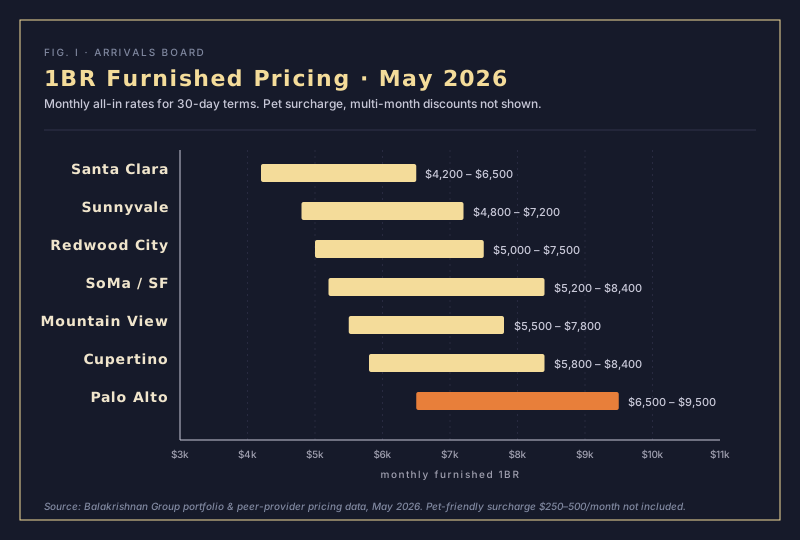
Pricing in May 2026 for furnished 1BR/2BR: $5,500-$7,800 (1BR), $7,200-$11,000 (2BR), 30-day terms. Pet-friendly inventory is tighter here than anywhere else in the Bay; expect $250-500/month surcharge.
What HR should know: If your relo is at Google North Bayshore and they want to be car-free, this is the only neighborhood where that actually works. Castro Street is also where they'll spend their weekends, and where international relos meet other international relos. The downside: 90-day inventory in May tightens to almost nothing by mid-month for any unit under $8,000.
Cupertino (Apple Park orbit)
Who lives here: Apple relos, almost exclusively. A handful of Tesla and supplier engineers spill in.
What it's like: Quieter than Mountain View, less downtown, more residential. Schools are excellent. Cupertino Union School District and Fremont Union High School District are the reason families pay the premium. Closer to Apple Park, but the walkable amenities are more limited.
Pricing: $5,800-$8,400 (1BR), $7,800-$12,500 (2BR). Premium for proximity to the spaceship. Apple's preferred housing partners take the high-end inventory, which leaves a thin middle.
What HR should know: Apple internal moves often expect Cupertino specifically. If you're placing a non-Apple employee here, expect them to be commuting to a different campus 20-40 minutes each way. The school district is the draw, but waitlists for incoming families during the school year are real. For an Apple-specific deep dive, see the Apple 2026 corporate housing playbook, which covers Apple's preferred-housing program, lease structures, and the Cupertino-vs-Palo-Alto school decision tree for family relos.
Sunnyvale (the workhorse)
Who lives here: LinkedIn, Google, Apple, Yahoo (still), and a long tail of mid-size companies. The most flexible neighborhood for a generic tech relo.
What it's like: A full city, not just a neighborhood, but the tech-relevant pockets are downtown Sunnyvale (around Murphy Avenue), Lawrence Station, and the Caltrain corridor. Recently revitalized downtown, real restaurant scene, decent schools.
Pricing: $4,800-$7,200 (1BR), $6,400-$10,500 (2BR). The best price-to-quality ratio in the South Bay.
What HR should know: This is where I send relos when they don't have a strong preference. Walkable downtown, central to most campuses, and the pricing has more flex than Mountain View or Cupertino. The catch: with a strong school preference, Sunnyvale's school assignments are less predictable than Cupertino's, and families sometimes end up in a school they didn't expect.
Santa Clara (Nvidia and the stadium)
Who lives here: Nvidia (the big one), Intel, AMD, Marvell, Synopsys.
What it's like: Less walkable than the others. Suburban, slightly older housing stock, but lots of new construction near Levi's Stadium and the Mission College area. Strong access to 101, 280, 880, and the airport. Football and World Cup event traffic is a real consideration this summer.
Pricing: $4,200-$6,500 (1BR), $5,800-$9,200 (2BR). Better value than Sunnyvale or Mountain View.
What HR should know: If your relo is going to Nvidia, this is the natural fit. Note that Nvidia headcount has been growing fast through 2025 and into 2026, and Santa Clara furnished inventory tightened earlier this spring than usual. June and July dates are getting locked up in May. The full breakdown of where each chip company places relos (Nvidia, Broadcom, AMD, Applied Materials, Lam Research) is in the semiconductor corp housing guide.
Palo Alto (the prestige tier)
Who lives here: Stanford-affiliated, finance and law executives, senior tech leadership, partners at firms.
What it's like: Higher price, walkable downtown (University Avenue, California Avenue), schools that consistently rank top of the state. Very specific tenant profile.
Pricing: $6,500-$9,500 (1BR), $9,000-$15,000 (2BR). The premium is real and not always negotiable.
What HR should know: Palo Alto is where you place senior executives and rare specialists. It's also where the lease drafting matters more, the screening matters more, and the management bandwidth matters more. If your relo is a Stanford visiting professor, partner-track lawyer, or a VP-level transfer, Palo Alto is the right read.
SoMa, Mission Bay, and North Beach (San Francisco)
Who lives here: AI lab relos (OpenAI, Anthropic, Stripe, Databricks), a heavy share of the FY2027 H-1B incoming class, and engineers who specifically want urban density.
What it's like: Apartments and condos, not single-family. Restaurant density, transit, and the ability to be car-free. The downside is well-documented: the city's central neighborhoods have been recovering through 2024 and 2025, and in 2026 they're meaningfully better but still uneven.
Pricing: $5,200-$8,400 (1BR studio/condo), $7,000-$13,000 (2BR). Wide range based on building age and amenity stack.
What HR should know: This is where the AI cohort wants to be. If your relo is going to SoMa-based AI labs, the answer is SoMa or Mission Bay. They will turn down a Palo Alto placement and ask to be moved within two weeks if you put them in the wrong neighborhood. The FY2027 H-1B summer wave is going to compress SoMa furnished inventory in June and July; lock terms in May.
Redwood City and San Mateo (the in-between)
Who lives here: Meta relos (Menlo Park is technically next door, but Meta employees fan out across the mid-Peninsula), Oracle, biotech.
What it's like: Real downtown in Redwood City, good restaurant scene, balanced family vs. young-professional mix. Pricing sits between Sunnyvale and Palo Alto.
Pricing: $5,000-$7,500 (1BR), $6,800-$10,500 (2BR).
What HR should know: This is where you send Meta relos who don't want to live in Menlo Park itself (which has more limited inventory and is more expensive). Caltrain access is excellent. Good fit for couples without strong school preferences.
What I tell HR teams
A few recurring patterns I've watched play out badly.
City-of-employer isn't always the right answer. Apple in Cupertino doesn't always mean Cupertino housing. A senior Apple legal hire with kids in middle school often does better in Palo Alto because the school system is the priority, even with the longer commute.
Pet-friendly isn't a bonus, it's a requirement. I covered the 81% pet-ownership figure for relocating tech employees before. If the relo has a dog, that constrains the neighborhood and the building set materially.
The summer 2026 squeeze is real. Between the H-1B FY2027 cohort, the summer intern wave, and the late-June medical residency intake at Stanford, UCSF, and Kaiser Bay, inventory in Mountain View, Sunnyvale, Santa Clara, Palo Alto, and SoMa is going to be more compressed than any summer since 2022. If your relo arrives in July, lock the unit in May.
Pricing isn't the whole story. The Sunnyvale 2BR for $7,000 and the Cupertino 2BR for $9,500 are not the same product. The schools, the commute, the noise profile, the walkability, the cell coverage, and the parking situation are all different. A $2,500/month difference can be the right call or the wrong call depending on the relo profile.
What to do this month
If you have summer 2026 relocations landing:
- Lock 60-day or 90-day terms in May for July arrivals; the spread between 30-day and 90-day pricing is roughly 10-15% in May and will compress to 0-5% by late June
- Confirm school district before confirming neighborhood for any family with kids 5-18
- Pet inventory needs to be bid 4-6 weeks ahead of move-in this spring
If you're sourcing housing for a senior hire:
- Palo Alto and Atherton (yes, Atherton has limited furnished inventory, but it exists) are the two real "executive tier" neighborhoods on the Peninsula
- The lease language for senior hires often needs more than the standard furnished agreement; expect to negotiate insurance riders and right-of-entry provisions
If you're doing your first Bay Area relocation:
- Mountain View, Sunnyvale, or Santa Clara is the safe default
- SoMa for anything San Francisco-based
- Don't overthink the prestige-vs-practicality question on a 60-day stay; you can always extend or move
The neighborhoods change personality fast. Mountain View in 2024 and Mountain View in 2026 aren't the same in terms of inventory tightness, pricing, or amenity stack. Whatever your past playbook was, refresh it for spring 2026.
If you're sourcing Bay Area corporate housing for summer 2026 relocations, we can run the numbers for your specific cohort: neighborhood mix, term length, pet requirements, and the timing windows that actually work this season.
Sources
- Bay Area Council Economic Institute — Bay Area Council
- California Department of Education — School District Search — California Department of Education
- Caltrain Service — Peninsula Corridor Joint Powers Board
- VTA Light Rail and Bus Service — Santa Clara Valley Transportation Authority
- Apple Park Information — Apple
- Nvidia Headquarters — Nvidia
Need to house a team?
Custom housing plan delivered within twenty-four hours. No obligation.
Request a Plan →