Where Nvidia, Broadcom, AMD & Applied Materials Relos Land in 2026
Chip company relos cluster differently than software. Where Nvidia, Broadcom, AMD, Applied Materials, and Lam Research are placing employees in 2026.
I had a Lam Research mobility coordinator email me last month asking about furnished housing in Fremont for an Indian process engineer relocating from Bangalore on a J-1. Six weeks later, the same coordinator was placing two more engineers, different countries (one from Korea, one from Taiwan), different visas (L-1, then EB-2), different timing windows. Same company, same job function, three completely different housing profiles.
This is what semiconductor relocations look like in 2026, and it's not what most general-purpose corporate housing playbooks are built around.
I've been managing furnished rentals across the Bay Area for 12 years. About a third of my inventory now serves corporate housing. The semiconductor share of that has grown notably since 2023, driven by the AI infrastructure capex cycle. Nvidia's headcount is up materially, AMD is competing for the same engineers, Broadcom integrated VMware and is still placing teams, and Applied Materials and Lam Research have been hiring on the equipment side as fab investment ramps.
Here's how chip company relos actually land in 2026 across the cities I work in.
Why semi relos differ from software relos
A few patterns I see consistently.
International share is higher. Software hiring is roughly 35-50% international depending on the company; semi hiring at engineering levels is often 60-75%. Taiwan, Korea, India, and increasingly Singapore dominate the inflow. That changes the visa mix, the housing-bills-credit-history picture, and the timeline.
Stays are longer. Software relos often run 30-90 days while the engineer finds permanent housing. Semi relos often run 90-180 days, sometimes 270 days, because the engineer is in a phase where they're shuttling to a fab in Phoenix, Hillsboro, or Taiwan for 2-4 week stints, and a full move-and-buy doesn't make sense until the role stabilizes.
Lab access defines location. Software relos can live anywhere with reasonable commute. Semi relos often need to be near a specific lab building, characterization fab, or test floor. Walking distance matters more, and the building set is smaller.
Family profile is older. The median semi engineer relo I place is 8-10 years older than the median software relo. More established families, more school-age kids, more multi-bedroom requirements.
Long-term plan is different. Software relos often plan to stay in the Bay Area indefinitely. Semi relos sometimes have a 3-5 year US assignment built into the offer letter, after which they may rotate back to Korea, Taiwan, or India. That changes how they think about housing, schools, and even car-buying.
Nvidia (Santa Clara)
Nvidia is the volume leader by a wide margin. Headcount has grown fast through 2024 and 2025, and the 2026 hiring pace is on the same trajectory. Most engineering roles cluster in the Endeavor and Voyager campuses on the north side of Santa Clara off Mission College Boulevard.
Where they're placing relos in May 2026: Santa Clara within 2 miles of campus is the first choice, Sunnyvale (Lawrence Caltrain corridor) second, San Jose (Berryessa, North San Jose) third for budget-conscious placements. Furnished 1BR within walking distance of the Endeavor campus is essentially booked through August at the moment.
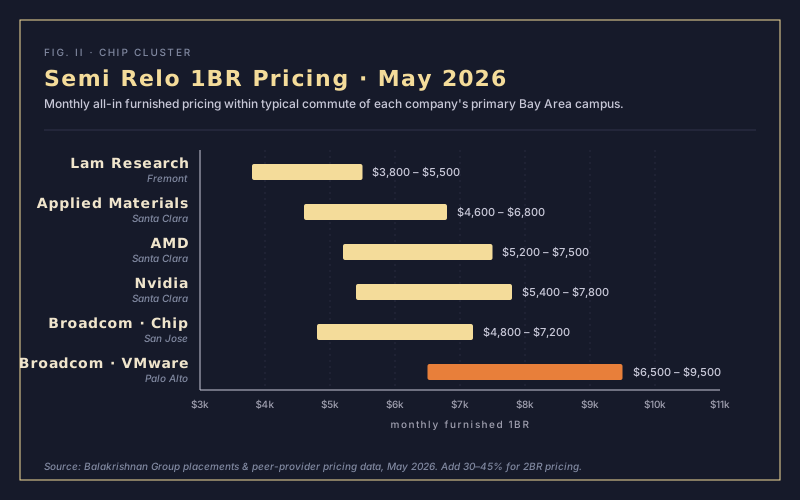
Pricing for the chip relo profile: $5,400-7,800 for 1BR, $7,200-10,500 for 2BR, premium for true walking-distance to campus.
What's distinct: Nvidia's growth is pulling in senior architects from Apple, Google, and Broadcom in addition to international new hires. The internal-hire profile prefers Sunnyvale or Mountain View over Santa Clara because they were already living there. The international new hires take Santa Clara because they don't yet have a sense of the area.
Broadcom (San Jose / Palo Alto)
Broadcom's footprint is split. Network silicon and the legacy semi business sit in San Jose. The VMware integration brought Palo Alto into the picture in a bigger way. Broadcom relos look more like Palo Alto relos than Santa Clara relos as a result.
Where they're placing relos: Palo Alto for VMware-side hires, San Jose (Edenvale, North First) for chip-side hires. The Palo Alto budget runs higher because Broadcom's VMware roles tend to be senior, and Palo Alto pricing reflects that.
Pricing: $6,500-9,500 for 1BR (Palo Alto), $4,800-7,200 for 1BR (San Jose). The split is wider than at any other chip company on this list.
What's distinct: Broadcom has more tax-equalized international relos than the average tech employer, in part because of the company's global structure. That changes the financial profile of what tenants can afford. Some Broadcom international relos look like Palo Alto-tier financial profiles even if their nominal cash compensation is mid-tier.
AMD (Santa Clara)
AMD's main Bay Area campus is in Santa Clara on Augustine Drive, plus the Pensando integration adds capacity. AMD has been competing directly with Nvidia for AI chip talent and the relocation pace has accelerated.
Where they're placing relos: Santa Clara is the obvious answer. Sunnyvale (Murphy/Mathilda) is the secondary option. AMD specifically draws a lot of architects with families from Austin (where AMD has another major campus), and the Austin-to-Bay-Area pattern often involves 2BR townhomes or single-family rentals rather than 1BRs.
Pricing: $5,200-7,500 for 1BR, $7,000-10,800 for 2BR.
What's distinct: the Austin pipeline. AMD employees rotating from Austin tend to know what they want. They've already decided whether they're trying single-family-with-a-yard or apartment-near-campus. That makes AMD relos some of the easiest from a placement perspective.
Applied Materials (Santa Clara)
Applied is a different animal. They're not designing chips, they're designing the equipment that makes chips. The engineering profile is heavier on chemistry, physics, and process engineering. Many engineers spend significant time at customer fabs (Intel in Hillsboro and Phoenix, TSMC in Phoenix, Samsung in Austin).
Where they're placing relos: Santa Clara primarily, with a meaningful Sunnyvale share for engineers who prefer the residential character of the Murphy Avenue area. Almost all placements are sub-30-minute commute to the Bowers Avenue campus.
Pricing: $4,600-6,800 for 1BR, $6,200-9,200 for 2BR. Applied tends to be slightly more cost-conscious on stipends than the chip designers, partly because the engineering profile skews to slightly less senior roles in absolute terms.
What's distinct: long stays. Applied engineers commonly book 6-9 month furnished stays because they're in and out of customer fabs for weeks at a time and a full move doesn't make sense until the project completes.
Lam Research (Fremont)
Lam is the East Bay outlier. Their main campus is in Fremont, off Stevenson Boulevard. Fremont's furnished inventory is structurally smaller than Santa Clara's, which makes Lam placements meaningfully harder than the chip-design companies.
Where they're placing relos: Fremont (Mission, Warm Springs) primarily, but a real share of Lam relos end up in Milpitas or Newark because Fremont's furnished 2BR inventory is tight. Some Lam engineers pick San Jose's Berryessa or North First Street because BART access works and the inventory is broader.
Pricing: $3,800-5,500 for 1BR, $5,200-7,500 for 2BR. The East Bay generally runs lower than the South Bay, which is one of the few places semi relo budgets stretch further.
What's distinct: BART matters more than at any other chip company. Lam relos who picked the wrong neighborhood end up with 70-minute one-way commutes, while ones who picked the right neighborhood (Fremont BART, Warm Springs BART, Milpitas) clear it in 25 minutes. The geography is unforgiving.
The Santa Clara / Milpitas / Fremont submarket
The chip cluster's submarket is structurally different from the broader corporate housing market.
Inventory is older. The Santa Clara furnished stock skews 1980s-1990s construction with more recent renovation. Mountain View and Palo Alto have more new-build furnished inventory. Tenants who care a lot about contemporary finishes will push back on Santa Clara stock.
Pricing has been catching up. Santa Clara furnished 1BR pricing was $4,200-5,800 a year ago; it's $5,200-7,500 now. The Nvidia-driven demand is the proximate cause, but Broadcom and AMD are pulling in the same direction.
The corridor extends north. As Santa Clara filled up, the demand spilled into Milpitas (toward the BART station) and into Lawrence/Caltrain in Sunnyvale. The spillover is now reaching into San Jose's Berryessa and the Lawrence Expressway corridor.
Visa and billing notes
H-1B remains the largest single visa across semi engineering, but the mix is more diverse than at software employers. I broke down the FY2027 H-1B summer cycle for Bay Area corp housing earlier this year. The patterns that show up more often at semi than at software:
L-1 intracompany transferees are a bigger share. Lam, Applied Materials, and Broadcom in particular run sizable L-1 programs because they have international subsidiaries with rotational engineering staff.
EB-2 and EB-3 advanced-degree pipelines are larger. Many semi engineers come in on EB-2 directly because they have masters or PhDs in specialized fields. The timeline from offer letter to start date can be longer (60-90 days vs. the 30-45 day software pattern), which gives mobility teams more lead time on housing.
Tax equalization is more common. Especially at Broadcom and Applied Materials, international relos often have tax-equalized packages that affect cash flow and stipend sizing. The mobility team is often working with international tax counsel, not just standard relocation services.
J-1 academic exchange shows up. Postdoc and visiting researcher programs from Korean universities (Seoul National, KAIST) and Taiwanese (NTU, NCTU) pipe a steady stream of 6-12 month J-1 placements into the Bay Area chip cluster. Different visa, different financial profile, different housing requirements.
What HR teams should do
If you're sourcing housing for semi relos in 2026:
- Lock 90-day terms for international new hires arriving June-September; the supply window in Santa Clara closes in May
- For Lam-bound relos, work backward from BART station access, not just from the campus address
- Plan for 6-9 month stays for Applied Materials engineers in customer-fab cycles, not the standard 30-90 day placement
- For Nvidia and AMD, expect more competing demand from Apple, Google, and Broadcom internal moves; budget for the spillover
If you're a one-off mobility manager handling your first chip company relo:
- The international visa profile changes the billing setup. Use a furnished provider that can bill the employer directly without requiring U.S. credit history or a U.S. bank account from the employee
- For 2BR placements with families, schools matter as much as commute. Cupertino and Sunnyvale district lines run differently than Santa Clara, and chip families with kids 5-18 will want the data before the lease, not after
If you're considering a 30-day vs. 90-day vs. 180-day placement length:
- 30 days assumes the engineer is house-hunting and will close fast; not realistic for international new hires
- 90 days is the practical minimum for an international engineer landing on L-1 or EB-2
- 180+ days is where Applied Materials and Lam Research engineers often end up
The chip cluster is going to keep absorbing housing share through 2026 and into 2027. The fab investment cycle has a 5-7 year tail, and the AI infrastructure cycle is at least 18-24 months from peaking on hiring. If your company has any chip exposure, the relocation pipeline is going to keep growing.
I covered the broader Bay Area corporate housing neighborhood guide for the general tech mix elsewhere. The chip-specific picture above is the layer underneath that, and the pricing in Santa Clara, Milpitas, and Fremont is moving fastest.
If you're sourcing Bay Area corporate housing for a semiconductor company in 2026, we can run the numbers for your specific cohort: Santa Clara, Milpitas, Fremont, San Jose, or Palo Alto, with the visa-and-billing setup that works for your international placements.
Sources
- Bay Area Council Economic Institute — Bay Area Council
- SEMI Industry Reports — SEMI
- Nvidia Investor Relations — Nvidia
- Broadcom Investor Relations — Broadcom
- AMD Investor Relations — AMD
- USCIS L-1 Intracompany Transferee — USCIS
Need to house a team?
Custom housing plan delivered within twenty-four hours. No obligation.
Request a Plan →